18+ (21+ in certain states). You must meet the applicable age and location requirements to open an account or trade event contracts. Availability varies by operator, product and jurisdiction.
Menu
Robinhood Prediction Markets review: venues, fees, and buying power
Robinhood Prediction Markets: the practical trade-offs
Robinhood’s event-contract service offers a route from an eligible brokerage account into several exchanges, with clear explanations of order fills and settlement stages. The trade-off is that familiar brokerage balances and app controls do not always mean what an event-contract user might expect. Buying power is separate, the current commission is price-weighted, sports visibility is not self-exclusion, and market access varies by residence and category.
Price-weighted and plan-dependent; capped at one cent per contract Source
Exchange fee
Up to one cent per contract, separate from commission Source
Funding
Event buying power is separate from brokerage cash Source
Order execution
Counterparty-dependent; partial fills possible Source
Full opt-out
Separate support process; hiding markets does not block trading Source
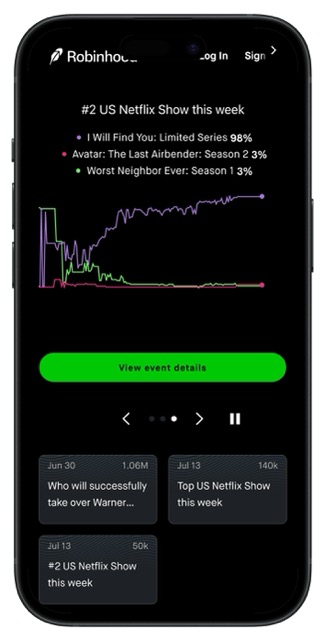
Robinhood event-contract interface image published by GamingToday (page updated October 31, 2026). Displayed prices are historical.
The broker and the exchanges
Robinhood Derivatives supplies the account interface. The current overview names KalshiEX, ForecastEX, Rothera and Crypto.com Derivatives North America. The relevant exchange, rather than the app brand alone, supplies the contract rules.
That structure makes the particular contract important. The exchange relationship can affect the contract rules and outcome determination, while Robinhood handles the account interface and associated processes. Not every product visible in the app has identical conditions.
The current commission is price-weighted, plan-dependent, rounded up to a cent and capped at one cent per contract. A separate exchange charge can add up to one cent per contract. The ticket’s total matters more than a flat-fee headline.
Older statement-help examples still use a flat commission. The newer overview reflects current pricing; the transaction history remains the record of what was actually charged.
Event buying power is separate from brokerage cash. Open orders reserve funds; unrealized gains are not spendable cash. Proceeds move through the event account and brokerage process.
The overview excludes instant brokerage credit, but dedicated funding help allows transaction-specific availability. The two pages disagree, so rely on settled cash and check the order ticket.
A market’s trading close, the event itself, the exchange’s resolution, and the resulting settlement value are different stages. Robinhood’s settlement guide says the exchange’s contract terms define the relevant outcome source and timing. A result that appears obvious from news coverage is not the same as a completed account settlement.
Proceeds also move through the event account and brokerage process before an external withdrawal. This explains why an event position showing a gain is not necessarily withdrawable cash. Processing times are the operator’s own estimates; your transfer may take longer.
The overview lists sports restrictions for residents of Maryland, Michigan, Nevada and, from Nov. 2, Ohio. Utah restrictions include sports, culture, elections, and politics. Additional restrictions can apply.
Access depends on residence and category; it is not nationwide. An accessible account or one available contract does not mean access to every subject.
A submitted order still needs a counterparty. Robinhood’s fill guide explains partial execution and cancellation of unmatched quantities; most orders use immediate-or-cancel handling, while eligible good-til-date orders can remain until expiry. Prices, liquidity, position limits, and account restrictions can all prevent an order from completing as initially requested.
Those rules matter more than a general claim that the app makes trading simple. They explain why the amount requested can differ from the amount executed and why an attempted sale may not fully close a position. The documentation describes possible behavior, not average fill speed or slippage across Robinhood’s exchanges.
Robinhood’s statement guidance distinguishes the profit/loss view from the detailed transaction history. A displayed realized result may exclude fees, while the history records transactions, fees, and settlement proceeds. A headline gain can therefore differ from the net movement a trader expects after accounting for transaction costs.
That is a practical interface consideration, not a tax recommendation. The annual statement is also distinct from a tax form. Rely on the actual trade record rather than a displayed account metric. What matters is whether the costs can be traced, not whether the headline number looks favorable.
Robinhood’s sports-visibility setting hides those contracts from parts of the interface, but it does not block trading. Full event-contract self-exclusion is a different process through support. Its help says the request may take time and positions must be closed before full disabling; notification controls are separate again. Understand these differences before you rely on a setting as a restriction.
The distinction between hiding content and disabling access is useful.
A familiar brokerage app does not make an event contract equivalent to the other balances or products displayed beside it. The derivatives account, exchange rules, transaction charges, and access restrictions all need to be checked on their own. Robinhood’s help provides meaningful detail on those points, although some help pages disagree with each other.
Our verdict therefore covers the product’s structure and limitations. It is not a recommendation for a particular contract or a claim of nationwide legality.
Key questions about the product, its terms, and its evidence limits.
Are Robinhood event contracts provided directly by Robinhood as an exchange?
The account-facing provider is Robinhood Derivatives, with contracts connected to named exchanges. The relevant exchange rules determine contract resolution. Source
Is the fee simply one cent per contract?
The current overview describes a price-weighted, plan-dependent commission capped at one cent per contract, plus a separate exchange fee up to one cent. Some older help examples still show a flat fee. Source
Can instant brokerage credit fund every event-contract order?
Not necessarily. The dedicated funding help says availability depends on the transaction, while the overview says it is unavailable. Use settled cash and check the order ticket. Source
Does hiding sports markets stop me trading them?
No. Visibility controls differ from the full self-exclusion process through support. Source
Why did my order only partly execute?
Only available matching quantity can fill. Immediate-or-cancel handling can remove the unmatched remainder, and price or account restrictions can also prevent execution. Source
Does a resolved event mean I can withdraw immediately?
Not necessarily. Resolution, account settlement value, and the transfer into withdrawable brokerage funds are separate processing stages. Source
Ian St. Clair is a journalist and editor whose published work spans sports, news, and features. His official PlayUSA profile describes reporting for the Fort Collins Coloradoan and Wyoming Tribune Eagle, alongside editing, fact-checking, and content strategy experience.
Mike Epifani is a writer and editor. His official Bonus.com profile documents a background in news, industry interviews, and product guides, with writing experience dating to 2013.
Read our editorial policy for how sources, product testing, and corrections are handled.
How we reviewed this product
We reviewed the operator’s published terms, help pages and fee schedules. Where hands-on testing is mentioned, it was published by the named writer and is linked to its source. Unless a section says otherwise, we did not add funds, trade or withdraw for this review, so processing times and fees are the operator’s own figures.
PlayPicks is owned by Catena Media. No operator paid to appear on this page, and we do not give it a score.
PlayPicks analysis is original synthesis. Linked provider documents remain the primary source for their own contract terms.
Important information
In the United States, certain event contracts are offered through Designated Contract Markets (DCMs) subject to oversight by the Commodity Futures Trading Commission (CFTC). Regulatory arrangements and product availability differ between platforms and jurisdictions. CFTC oversight does not constitute approval or endorsement of any particular contract. Event contracts are derivatives products, not sports betting or gambling products, and are not licensed by any state gaming or gambling regulator.
Trading event contracts involves substantial risk of loss. You may lose some or all of the funds you use to trade. Past results do not guarantee future outcomes.
Nothing on this page constitutes investment, trading, or legal advice, or a recommendation to buy or sell any contract. Content is for general informational purposes only.